|
What happens when fire occurs?
Click here to see what happens when fire occurs.
Fire Development is a function of many factors including: fuel properties, fuel quantity, ventilation (natural or mechanical), compartment geometry (volume and ceiling height), location of fire, and ambient conditions (temperature, wind, etc).
Traditional Fire Development
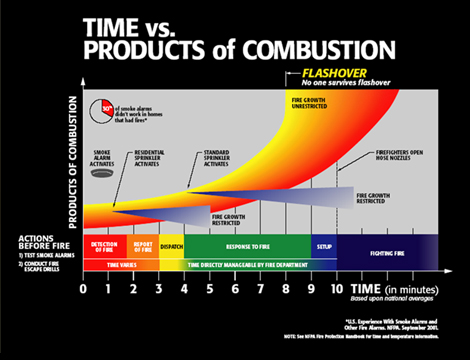
The Traditional Fire Development curve shows the time history of a fuel limited fire. In other words, the fire growth is not limited by a lack of oxygen. As more fuel becomes involved in the fire, the energy level continues to increase until all of the fuel available is burning (fully developed). Then as the fuel is burned away, the energy level begins to decay. The key is that oxygen is available to mix with the heated gases (fuel) to enable the completion of the fire triangle and the generation of energy. That is of course until you have a fire sprinkler activate.
National Research Council of Canada
Room - Fire Growth
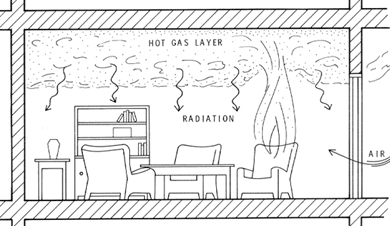
When an object in a room starts to burn (such as the armchair in Figure 2), for some time after ignition, it burns in much the same way as it would in the open. After a short period of time, however, confinement begins to influence fire development. The smoke produced by the burning object rises to form a hot gas layer below the ceiling; this layer heats the ceiling and upper walls of the room. Thermal radiation from the hot layer, ceiling, and upper walls begins to heat all objects in the lower part of the room and may augment both the rate of burning of the original object and the rate of flame spread over its surface.
At this point, the fire may go out if, for example,the first object burns completely before others start, or if sufficient oxygen cannot get into the room to keep the object burning. Sometimes, however, the heating of the other combustibles in the room continues to the point where they reach their ignition temperatures more or less simultaneously. If this occurs, flames suddenly sweep across the room, involving most combustibles in the fire. This transition from the burning of one or two objects to full room involvement is referred to as 'flashover'.
Usually at the time of flashover, windows in the room will break, allowing for the entry of fresh air. The fire burns vigorously for some time until the combustibles are mostly consumed. Flaming eventually ceases, leaving a mass of glowing embers.
The course of a compartment fire can be expressed in terms of the average gas temperature in the room. Figure 3 illustrates three stages of such a fire:
- The growth or pre-flashover stage, in which the average temperature is low and the fire is localized in the vicinity of its origin;
- The fully developed or post-flashover fire, during which all combustible items in the compartment are involved and flames appear to fill the entire volume; and
- The decay or cooling period.
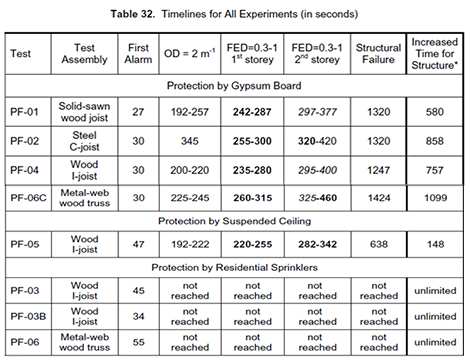
The most influential factor to stop this is a Fire Sprinkler system, the introduction of a Fire Sprinkler to a fire changes everything. The Chart below is from a recent test conducted by the National Research Council of Canada. It demonstrates fire growth first without Fire Sprinklers (FED indicates time to incapacitation), then with Fire Sprinklers. Notice that FED is not reached nor does floor collapse occur when fire sprinklers are present.
|
|
|